Decoding RNG Certification Protocols Across Digital Cricket War, Andar Bahar, and Multi-Deck Baccarat Variants on Unified Mobile Frameworks
Ines Werner · Sep 30, 2026
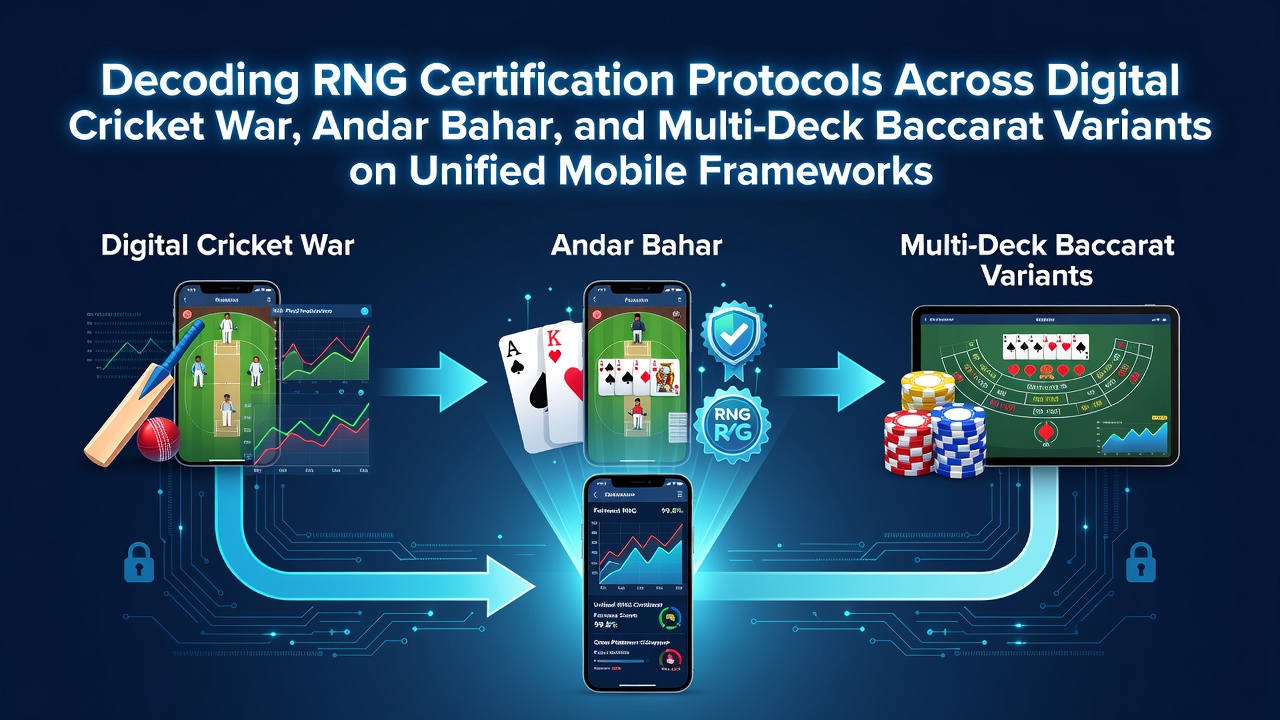
Decoding RNG Certification Protocols Across Digital Cricket War, Andar Bahar, and Multi-Deck Baccarat Variants on Unified Mobile Frameworks
Digital Cricket War combines cricket simulation mechanics with card-based outcomes while Andar Bahar relies on sequential card draws from a single deck and multi-deck Baccarat uses eight decks shuffled together, yet all three titles require RNG certification before deployment on unified mobile frameworks, and operators must demonstrate compliance through independent laboratory testing that verifies statistical randomness across millions of simulated rounds.
Core Components of RNG Certification Standards
Certification begins with source code review where laboratories examine the algorithm implementation for predictability flaws, after which statistical test suites such as DIEHARD and NIST SP 800-22 are applied to generated sequences to confirm uniformity and independence, and these procedures apply equally to cricket-themed randomizers that determine shot outcomes, to Andar Bahar shufflers that decide side bets, and to Baccarat shoe generators that select banker or player wins.
Researchers at institutions including the University of Nevada Reno have published methodologies that extend basic randomness checks to game-specific entropy requirements, so that Cricket War variants must prove no bias in over-under totals while Andar Bahar sequences must maintain exact 50/50 side probabilities even after thousands of consecutive rounds.
Adaptations for Mobile Unified Frameworks
Unified mobile platforms consolidate multiple game engines into a single application binary, which means RNG seeds and state management must remain isolated between titles to prevent cross-contamination, and certification bodies therefore require separate test reports for each variant even when they share the same underlying random number library, and this separation becomes especially relevant when live updates occur in September 2026 across platforms serving both Indian and European markets.
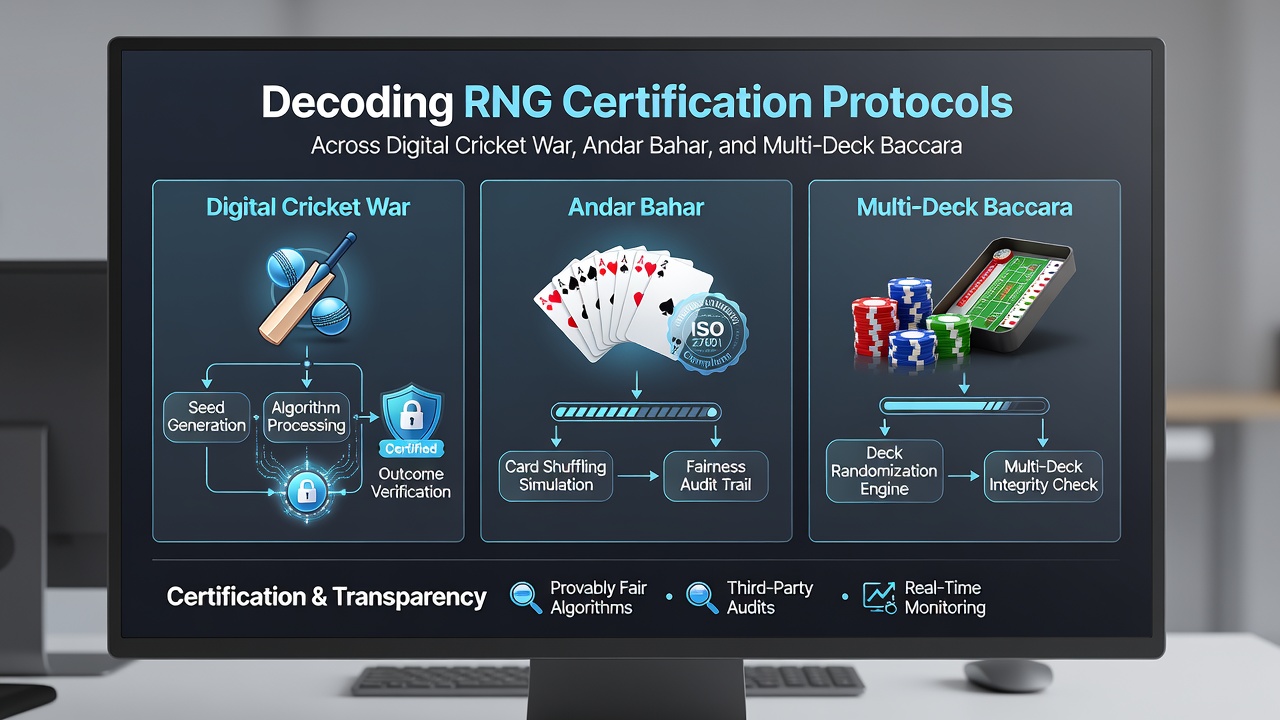
According to reports from the Malta Gaming Authority, mobile RNG implementations must also undergo hardware abstraction layer testing because device-specific processors can introduce timing variations that affect seed generation, and auditors therefore run parallel tests on Android and iOS builds to confirm identical statistical properties before granting approval for unified distribution.
Variant-Specific Testing Protocols
Digital Cricket War introduces additional layers because random events map to cricket statistics such as boundary probabilities and wicket falls, so certification includes verification that these derived probabilities match published mathematical models rather than raw RNG output alone, and one study revealed that mapping errors accounted for most certification failures in sports-themed titles during 2025.
Andar Bahar certification focuses on deck penetration and side-bet fairness because the game draws until a matching card appears, which creates natural dependencies that standard independence tests must accommodate, and laboratories therefore apply Markov chain analysis to confirm that observed frequencies align with theoretical expectations across extended sessions.
Multi-deck Baccarat demands extra scrutiny of shuffle algorithms because eight decks increase the state space dramatically, and certification reports must demonstrate that continuous shuffling machines or electronic equivalents produce distributions free from detectable patterning even when players track previous results across hundreds of hands.
Regulatory and Laboratory Oversight Practices
The Australian Communications and Media Authority maintains a registry of approved testing houses that operators must use for market access, and these bodies coordinate with iTech Labs and Gaming Laboratories International to issue certificates valid across multiple jurisdictions, while data from 2024 shows that average certification timelines for multi-game mobile titles range between six and nine weeks depending on the number of variants submitted simultaneously.
Those who manage unified frameworks often discover that a single RNG library update triggers re-certification for every attached title, and this requirement has prompted developers to implement modular architectures where only the affected module undergoes re-testing, and the approach reduces both cost and time while preserving compliance integrity.
Conclusion
Certification protocols continue to evolve as mobile frameworks incorporate new hardware capabilities and as regulatory expectations rise, yet the fundamental requirement remains unchanged: each game variant must demonstrate independent, unbiased random outcomes through documented laboratory processes before players access the titles on unified applications, and operators who maintain current certificates across Cricket War, Andar Bahar, and multi-deck Baccarat variants position themselves to meet both existing and anticipated compliance demands.